
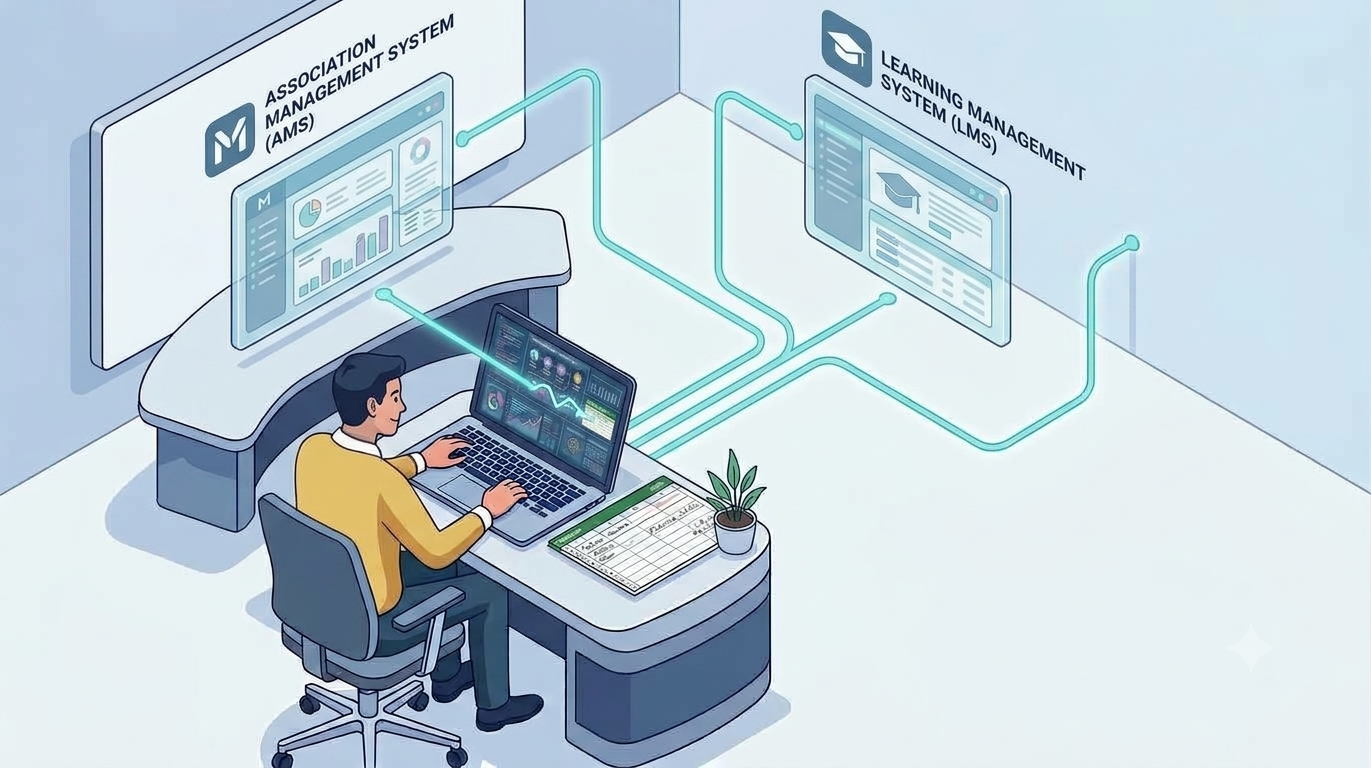
A membership management system. An LMS. An event platform. A CRM. Email marketing tools. Maybe a few specialized platforms for certification, communities, surveys, or reporting.
Individually, these tools may work perfectly well.The problem starts when your team has to work across all of them.
Data gets moved manually. Staff maintain spreadsheets. Members enter the same information more than once. A simple report requires pulling information from three different systems.
At some point, the technology that’s supposed to make work easier starts creating more work.
That’s when your technology stack becomes the bottleneck.
If you’re evaluating your current setup, the Empowered Association Tech Stack Audit is a useful place to start. It can help you think through the systems, integrations, and workflows your association needs before adding another platform.
Here are five signs your technology stack may be holding your association back.
1. Your team spends more time moving data than using it
A member updates their information in one system, but someone has to update it somewhere else. An event registration lives in one platform while engagement data sits in another.
Marketing needs a list based on membership status, event attendance, and engagement, so someone exports multiple reports and combines them in Excel.
The work gets done. But none of it actually moves the association forward.
And every manual handoff creates another opportunity for errors, outdated information, or duplicated records.
If your team regularly says, “I’ll pull that report,” or “Let me check another system,” it may be time to look at what’s happening between your platforms.
2. Your members experience your systems as separate organizations
They see one association.So when they have to log into multiple platforms, repeat information, or receive communications based on outdated data, the technology becomes part of the member experience—and not necessarily in a good way.
A member may attend your conference, complete a course, participate in your community, and renew their membership.
If those activities live in separate systems with no meaningful connection, your association may never get a complete picture of that member.
The result is a fragmented experience for both the member and your staff.
3. Simple requests turn into IT projects
Marketing wants to create a new member segment.
Education wants to trigger a communication after someone completes a certification.
Membership wants to add a new field.
Leadership wants a dashboard combining membership, events, and engagement.
If each request requires custom development, a vendor ticket, another integration, or weeks of coordination, your technology may be limiting what your teams can do.
Eventually, people stop asking: “What should we do?”and start asking:”Can our systems actually do that?”
That’s when technology debt becomes operational debt.
4. Your spreadsheets have become a second technology stack
One spreadsheet tracks member information. Another reconciles records.Someone maintains an event list. Another person owns the report that only they know how to update.
It works—until it doesn’t.The person who built the spreadsheet leaves. A formula breaks. The organization grows. Someone needs a new report with one additional data point.
Suddenly, a simple spreadsheet has become critical infrastructure.
If your team has built a collection of workarounds around your existing systems, that’s a signal worth paying attention to.
5. You're adding tools to solve problems created by other tools
So you add another tool.Then you need an integration to connect the two.
Eventually, your technology environment becomes a collection of platforms that technically exist together but don’t necessarily work together. More technology doesn’t always mean more capability.
Sometimes it means more places for work to get stuck. Before adding another platform, ask:
Can our existing systems work better together?
That question can save your association from another technology purchase that solves one problem while creating another.
So, what should you do?
Start by looking at the workflow between them.
Pick one important process—such as:
Member joins → payment → profile creation → welcome communication → event participation → education → renewal
Your technology should support the association—not become another team to manage
The goal isn’t necessarily fewer systems. It’s a technology environment where your people, data, and systems work together.